Modular construction is a building method. Complete modules or specialist components are manufactured off-site in a controlled factory environment, then transported and assembled on location. Adoption is accelerating among UK developers for a simple reason: projects can finish 30–50% faster than traditional builds. Less disruption. Consistent, factory-controlled quality.
For commercial developers, contractors and public-sector clients, the appeal is practical rather than theoretical. Offsite production can shorten programmes and reduce exposure to poor weather. It can also move a substantial share of construction activity away from constrained sites - useful when standardised designs or repeatable components are required across a project.
What Counts as Modular Construction (Quick Definition)
Modular construction covers buildings and building elements produced away from the final site, under controlled manufacturing conditions. The completed units travel to the development and get installed onto prepared foundations, or integrated into the main structure.
Some projects use volumetric modules containing walls, floors, ceilings and internal finishes. Others combine traditional construction with specialist prefabricated components - bathroom pods, service modules, structural panels. Either way, the defining principle stays the same: meaningful construction and finishing work happens in a factory before installation on site.
This approach shouldn't be confused with temporary or low-spec accommodation. Modular methods can deliver permanent, regulation-compliant buildings designed for intensive use. How much of the work happens in the factory depends on design, logistics, planning constraints and each scheme's procurement strategy.
Why Adoption Is Accelerating - Speed, Disruption and Quality
Programme efficiency is one of the strongest reasons developers consider modular construction in the UK. Factory manufacturing can run while foundations, utilities and access works progress on site. Overlap these activities rather than complete them sequentially, and modular projects can finish 30–50% faster than comparable traditional builds.
Why does that matter? Faster delivery is particularly valuable where a facility must open by a fixed date. Or where existing operations need to continue during construction. Or where delayed occupation would hit revenue. The method doesn't remove the need for careful planning - but it does transfer more work into a repeatable production process with clearer sequencing.
Offsite manufacturing also reduces activity at the development site. Fewer wet trades. Less cutting, storage and assembly. Lower noise, less traffic, fewer vehicle movements. These benefits matter on occupied campuses, hospital estates, retail locations and dense urban plots, where access and neighbour disruption must be tightly managed.
Quality control is another important factor. Indoor manufacturing avoids weather delays and protects materials and unfinished interiors from rain, frost and excessive moisture. Factory teams follow defined inspection procedures in stable conditions - that makes strict quality control easier to apply across repeated units.
Modular delivery can also improve environmental performance. Controlled production lets materials be measured and used more efficiently, which means less waste. Better detailing and repeatable installation support improved energy efficiency. Shorter site programmes and fewer deliveries lower the carbon footprint too.
Where It's Being Used - Healthcare, Education, Commercial, Residential
In education, modular systems deliver classrooms, specialist teaching spaces and school expansions. They allow additional capacity with less interference to pupils, staff and the surrounding community. Work concentrates away from the school site; installation gets planned around operational requirements.
Healthcare applications include wards, clinics and testing hubs. These schemes often involve demanding services coordination, hygiene standards and programme deadlines. Factory production helps teams repeat room layouts, coordinate building services and inspect finishes - all before modules ever reach a live healthcare estate.
Commercial uses include offices and retail facilities, particularly where speed to occupation and consistent internal specifications matter most. Modular techniques can also support phased developments. Organisations add capacity in line with operational demand, rather than all at once.
Residential applications include housing and rooftop extensions. Rooftop modular construction can be especially useful where lightweight units must go onto a constrained existing building - limited space for storage, prolonged site activity, tight access. Across every sector, though, suitability depends on early coordination between designers, manufacturers, logistics teams, contractors and building-services specialists.
Regulatory Standards and Building Lifespan
Modular construction faces the same core compliance expectations as any other form of development. Buildings delivered through offsite methods must meet UK Building Regulations, including fire safety and energy efficiency.
Compliance needs to be designed into the system, not treated as an installation-stage exercise. Fire strategy, structural performance, thermal detailing, ventilation, accessibility, service penetrations - all of it has to be coordinated across factory-made elements and site-built interfaces. Responsibilities for design approval, inspection, certification and installation tolerances should be clear from the outset.
Permanent modular structures can last 50+ years when appropriately designed, manufactured, installed and maintained. Lifespan depends on specification, exposure, maintenance and the quality of connections and weatherproofing. Not simply on whether construction happened in a factory or on site.
Specialist Modular Components - The Role of Bathroom Pods in Commercial Schemes
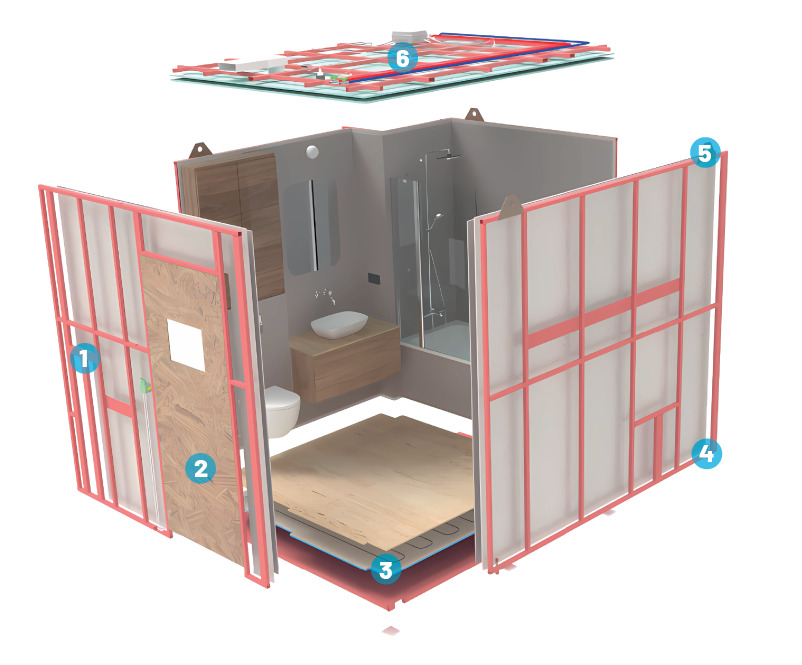
Bathroom pods show how modular principles apply within a larger conventionally built or hybrid development. For project teams assessing what is modular construction, pods offer a clear example. Bathrooms get assembled and finished off-site, transported as coordinated units, then connected to the building's services on location. Fewer trades in confined areas. More consistency across repeated room types. Simpler inspection before installation.
The benefits are particularly relevant to hotels, student accommodation, residential developments and healthcare schemes, where numerous bathrooms share similar layouts and specifications. Early coordination still matters. Structural openings, lifting routes, service connections, waterproofing interfaces and tolerances all need to align with the wider design.
Domczar manufactures prefabricated bathroom pods with a production capacity of 9,000 units per year. The company holds ISO 9001 and ISO 14001 certification. Its 2025 references include a Dublin project involving 457 units, a Warsaw scheme with 362 units and student accommodation in Garbsen - projects that show how specialist modular components support repeatable delivery across large commercial and accommodation-led developments.
FAQ
What is modular construction?
Modular construction is a method in which building modules or specialist components are manufactured off-site in a controlled factory environment, transported to the development and assembled or installed on location.
Why are UK developers adopting modular construction?
The main drivers are shorter programmes, reduced site disruption and controlled manufacturing quality. Projects can finish 30–50% faster than traditional builds. Factory production can also reduce waste, weather exposure, noise, traffic and vehicle movements.
Are modular buildings permanent?
Yes. Modular construction can deliver permanent structures that meet UK Building Regulations, including fire-safety and energy-efficiency requirements. Properly designed, installed and maintained, permanent modular structures can last 50+ years.