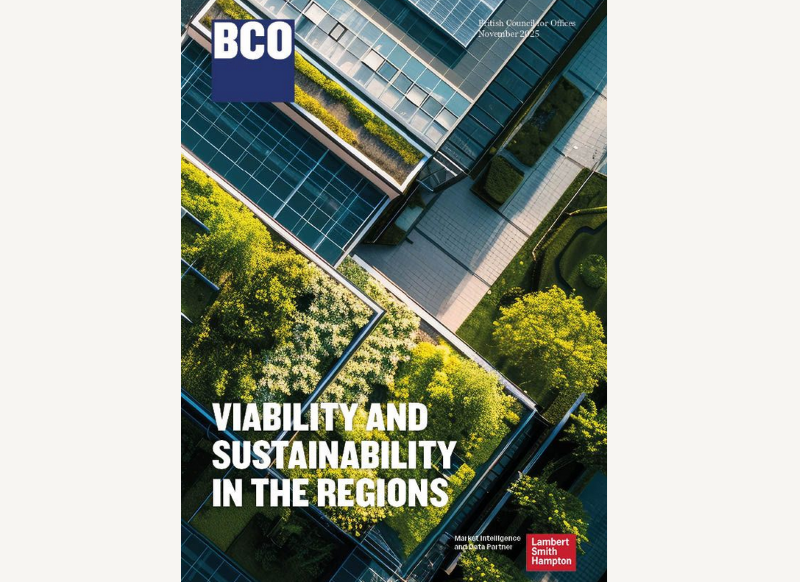
A stark regional imbalance in the proportion of highly sustainable office buildings across the UK threatens the economic growth of smaller regional cities and could undermine national net zero ambitions, according to new research from the British Council for Offices (BCO).
The BCO’s Viability and Sustainability in the Regions report warns that if the current imbalance remains unaddressed, a significant portion of regional office stock risks becoming economically obsolete, hindering economic growth and potentially leading to “sustainability gentrification”.
The report reveals that while London and the “Big Six” regional cities of Birmingham, Bristol, Edinburgh, Glasgow, Leeds and Manchester offer a concentration of modern, sustainable offices, smaller, yet economically important, regional cities such as Exeter, Newcastle and Sheffield lag considerably.
This imbalance poses a critical challenge for national and international organisations with robust ESG commitments, hindering their ability to secure suitable office spaces outside major metropolitan hubs.
Key findings include:
- The Big Six cities average 19 highly sustainable office buildings, compared to just three in Exeter, Newcastle and Sheffield.
- Even when adjusted for city size, the gap persists: Newcastle and Sheffield have five to six highly sustainable offices per million sq m, versus an average of 11 in the Big Six.
- Higher EPC ratings (A+, A and B) are approximately twice as prevalent in the Big Six compared to smaller regional markets.
Long-term implications
While the immediate impact of this disparity on occupiers in regional cities varies – with some businesses having to compromise on their sustainability goals – the long-term implications are far more significant. As energy regulations tighten, the prospect of carbon taxation grows and demands for comprehensive emissions reporting intensify, the need for high-performing buildings will only increase.
The report reveals a fundamental misconception that hampers progress and innovation: the conflation of “prime” and “sustainable” office space. From an embodied carbon perspective alone, the most sustainable office is the one that is already standing and occupied – sustainable offices inherently require high specification and a long list of industry certifications.
The report proposes a shift away from established sustainability accreditation schemes. It found that these certification systems, while valuable, can be too complex, costly and focused on potential rather than actual operational performance for regional markets needing practical solutions. Instead, regional office markets need simple, meaningful sustainability performance metrics that prioritise in-use building performance.
The report says moving away from “sustainable means prime” would alter the viability equation for both developers and occupiers in regional markets. This distinction has the potential to open new pathways for improving the sustainability of offices outside London and the Big Six office markets while retaining heritage and local character.
Eric Chong, director of research & policy at the BCO, said: “This paradigm shift would require a rewriting of the rulebook and comprehensive education for many investors, occupiers, agents and local stakeholders. The current focus on new-build solutions overlooks the critical importance of retrofitting existing stock to achieve genuine sustainability outcomes while also maintaining the unique character and heritage of the local built environment.”
A new approach: the city office portfolio
To support a more balanced distribution of sustainable office provision, the BCO proposes a strategic shift towards a “city office portfolio” approach. This framework encourages cities to take a holistic view of their office stock, developing co-ordinated visions and action plans that:
Foster collaborative leadership by establishing “Sustainable Property and Commercial Engagement” (SPACE) groups to drive a shared agenda among public and private sector stakeholders.
Develop “fit-for-place” solutions by implementing a tailored “toolkit” of interventions that respond to local market conditions, prioritising the strategic retrofitting and refurbishment of existing assets.
Prioritise performance by shifting the focus from relying solely on upfront certifications to valuing and measuring a simple set of sustainability criteria, including a core set of building performance metrics and operational efficiency.
Incentivise sustainable practices by exploring fiscal policies, planning mechanisms and regulatory adjustments that make sustainable upgrades economically viable and appealing in regional markets.
Build local capacity by investing in upskilling the regional supply chain to strengthen local expertise in delivering high-quality, sustainable office spaces.
Delivering this transformation will require multiple co-ordinated levers: reform of planning requirements, comprehensive stakeholder education and collective sector adoption. To achieve these goals, the report provides a toolkit of 21 potential pathways and interventions. These include measures at the asset level (such as retrofit strategies and energy efficiency improvements), industry-wide practices (such as addressing the landlord-tenant split incentive) and policy levers (such as regulatory adjustments to support sustainable refurbishments).
Nick James, Sustainability Director at Futureground and co-author of the report, said: “Addressing the regional disparity in highly sustainable offices is not simply an environmental imperative – it is essential to securing the long-term economic resilience and competitiveness of all UK cities.
Jaime Blakeley-Glover, Head of Regenerative Futures at LSH and fellow co-author, added “By adopting a collaborative, place-based approach and implementing targeted interventions, we can unlock the potential of regional office markets, foster thriving business environments and contribute to a more sustainable future for the entire nation. The time for decisive and co-ordinated action is now – but it demands a fundamental shift in how we perceive and collaborate within regional office markets.”
Read the report at: https://www.bco.org.uk/research-report/viability-and-sustainability-in-the-regions