Householders who are least able to pay for their heating bills are to be targeted to receive energy efficiency support.
The Government’s Energy Company Obligation (ECO) scheme is to be extended to September 2018, as outlined by the Department for Business, Energy & Industrial Strategy at the end of January 2017.
Many homes which are the most difficult to heat are classed as hard to treat and these tend to be occupied by those least able to pay.
Standard forms of cavity wall insulation may not be possible for a number of reasons. These properties may have irregular or narrow cavities which restricts the use of conventional blown cavity wall insulation, or have defective/corroded wall ties, or be unsuitable for external wall insulation due to planning restrictions. Other reasons could be where internal wall insulation may disrupt tenants, or those located in high or severe wind driven rain exposure zones, or where properties are at risk of flooding.
The use of injected polyurethane foam can provide the best solution for these properties. The process can easily be used for walls or sprayed in as roof insulation to effectively insulate most housing. Closed cell polyurethane foam has been around for over 30 years. The polyurethane insulant is a two-component liquid system which produces a highly-efficient blanket of insulation with an exceptional thermal conductivity figure. Systems can be applied to various depths and have K-values in the range of 0.025 to 0.028W/mK.
For cavity wall insulation, injected polyurethane foam provides a superior performing insulant which also helps to bond the inner and outer leaves providing strength to the building.
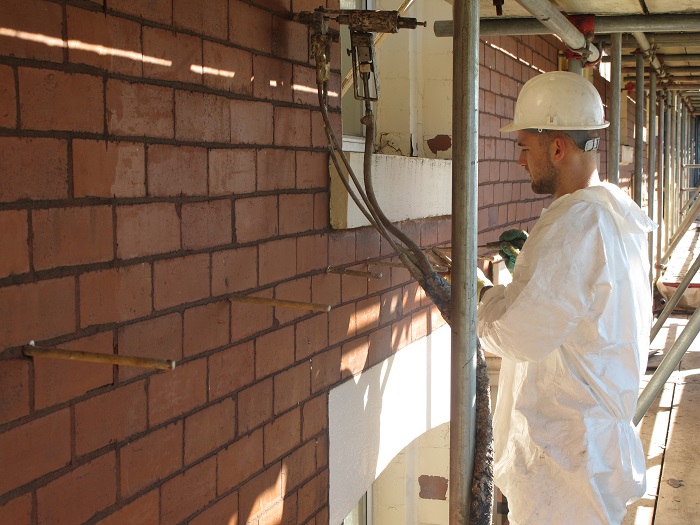
Air leakage through the cavity can be reduced to zero. Because of the greater thermal performance and the reduced air leakage polyurethane foam outperforms all other forms of cavity fill. Injected polyurethane cavity wall insulation can be used in flood-plain areas to provide an additional barrier against water ingress through the walls.
Often occupiers living in hard-to-treat properties may be classed as living in fuel poverty, whereby a large proportion of their income is required for heating their homes. They may be elderly or vulnerable and would particularly benefit from well insulated homes.
In fact, it is often these people who end up in hospital with cold-related illnesses. If all homes were brought up to a decent standard of energy efficiency this could certainly relieve some of the pressure on hospitals both in terms of admissions and the resultant cost savings.
Polyurethane foam is often the most cost effective solution for uninsulated cavity walled properties, including those classed as hard-to-treat. The British Urethane Foam Contractors Association represents professional installers of sprayed and injected polyurethane foam systems.
A BUFCA twenty-five year insurance warranty is available for cavity wall insulation projects.