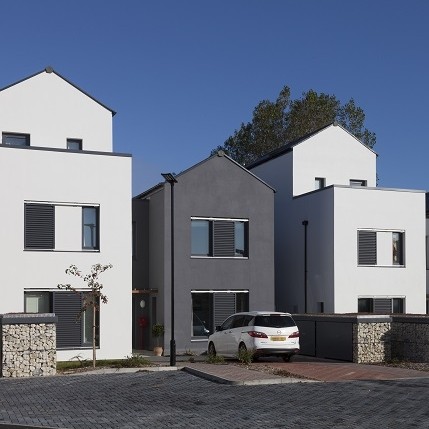
H+H’s Thin-Joint System of aircrete blocks and Celfix Mortar is a key element in the construction of a Passivhaus development of 16 semi-detached houses and 12 sheltered accommodation apartments on the Isle of Wight.
The scheme’s developer, Southern Housing Group, wanted a scheme to meet the low energy criteria defined in the higher levels of the Code for Sustainable Homes without having to rely on renewable technologies. The fabric first, low-energy approach embraced by Passivhaus meet this criterion.
A Passivhaus must be built according to the principles developed by the Passivhaus Institute. These seek to minimise the need for space heating on the basis that minimising heat losses through the building fabric is the most cost-effective and robust way of achieving a low carbon building. The solution relies on maximising the use of fabric insulation, minimising thermal bridges and ensuring buildings are airtight.
External walls of homes on the Cameron Close development are constructed from H+H’s 200mm thick thermally efficient Celcon Plus blocks. These are enhanced externally by an additional 230mm thick layer of phenolic insulation on the houses and 150mm thick layer on the apartments. The insulation is finished externally with a white-colour acrylic render system, a common aesthetic on the Isle of White. The solution gives a U-value of just 0.08W/m2K for the external walls of the houses and 0.11W/m2K for the apartment walls.
In addition to its insulating properties, H+H’s Thin-Joint solution is ideal for Passivhaus construction because the combination of accurately dimensioned Celcon Plus blocks with 2mm thick Celfix mortar joints helps to minimise air leakage through the external walls. David Harris, director or Stoneham Construction is an advocate of the Thin-Joint System: “Passivhaus is all about air tightness so if you can reduce the gap between blocks to 2mm, instead of 10mm, it makes life a lot easier,” he says.
Achieving an airtight build was further helped by the use of H+H’s Retro Fit Joist Hangers to carry the timber joists that support the internal floors of the homes. These enable the wall to be built first with the hangers added after to avoid the need to cut blocks or to penetrate the blockwork walls speeding construction and improving airtightness.