Glenigan | A Hubexo Product, one of the construction industry’s leading insight and intelligence experts, releases its widely anticipated UK Construction Industry Forecast 2027-2028.
Predominantly focused on underlying projects (less than £100m in value), unless otherwise stated, it contains a comprehensive overview of the current state of the construction industry and provides a forecast over the next two years.
Glenigan’s 2027-2028 Forecast reappraises the predictions made during the Summer 2026 edition, while still maintaining the broad expectation that the sector will start seeing the green shoots of recovery next year with further gains made over the next 24 months.
Unsurprisingly, given the events of the past six months, 2026 will finish on a low note, posting an overall decline of -13%. This figure is far lower than expected earlier in the year, persuading Glenigan to fully re-evaluate the predictions from its Summer Forecast. This double-digit decline of the construction sector is prompted by persistent socio-economic turmoil, ongoing international conflict and lingering political uncertainty, which the new Burnham-led Government has yet to overcome.
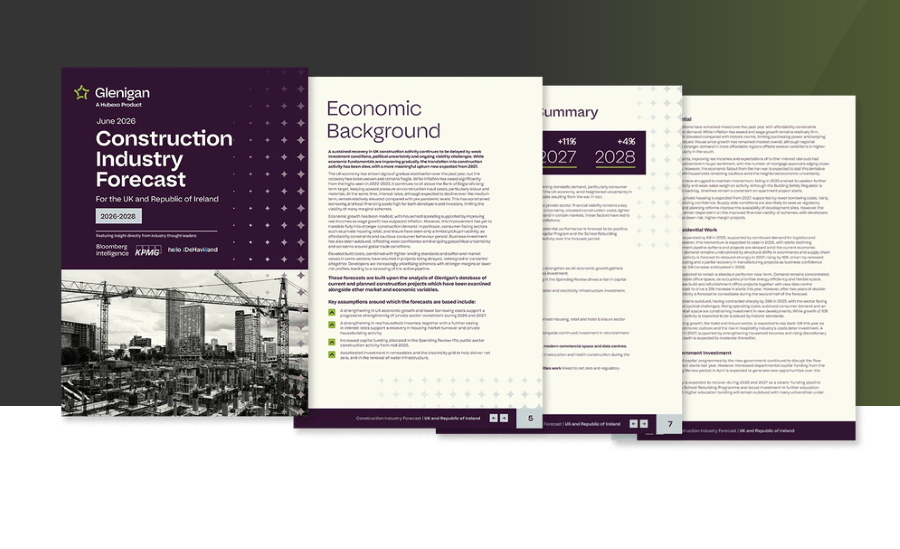
However, despite this challenging set of circumstances, Glenigan’s Economics Unit, which researched and produced this Forecast, predicts an industry-wide uptick in activity in 2027 (+11%) and 2028 (+7%). Whilst these figures are lower than calculated in the Summer, sustained growth will likely emerge, supported by a combination of increased public sector spending and a tentatively improving private sector appetite for investment in residential and commercial projects.
Looking ahead to 2027 and beyond, Allan Wilen, Glenigan’s Economic Director, sees a silver lining to the current overcast cloudscape: "Momentum is picking up, particularly as funds from the Spending Review are released and public projects, utilities upgrades and critical infrastructure investment gradually start to come online. We believe this, combined with impetus in specific private sector niches like offices and data centres, will have a fortifying effect across the rest of the industry. It could potentially spark a chain reaction leading to sustained recovery in the second half of next year, which may be maintained throughout 2028."
It is worth reminding ourselves that UK construction has experienced an unusually long period of decline, reflecting developments in the macro economy.
The Russia-Ukraine war forced the industry to find new supply arrangements. Then, conflict between the US, Israel and Iran pushed energy prices, inflation and borrowing costs higher. Living costs rose and the labour market weakened. Momentum and enthusiasm for new projects soon faded.
Private sector work has been hit hardest, with fluctuating financial viability affecting many schemes. Build costs are high, lending has tightened and demand has softened in some sectors. As a result, numerous projects have been redesigned, delayed or cancelled.
As Allan Wilen explains: "Early signs of recovery gave the sector hope, then unforeseen events disrupted it again. Conflict in the Middle East arrived alongside political upheaval at home and, just as the industry adjusts to one challenge, another arrives. If you'd asked anyone in January, I doubt they'd have predicted a new Prime Minister by the summer, with a new Cabinet and new ministers to match. The government is still finding its feet after a 'steady-as-she-goes' Budget. The effect of new policies and spending, on top of existing commitments, is yet to be seen."
Forecasts now point to a deeper decline as 2026 draws to a close. But despite these many issues, the stage is being set for the industry's resurgence.
In the view of Allan Wilen, "Public sector spending is where we expect the recovery to begin. Backed by the School Rebuilding Programme, the New Hospital Programme and water investment under AMP8, education, health and civil engineering verticals are all expected to grow steadily next year. Social housing is also expected to grow in both 2027 and 2028. When public schemes start moving, private investors are more likely to follow and we expect that to build from the second half of 2027, although it depends on funding turning into construction starts."
It’s true that the increased capital funding, announced in the last Spending Review, has been slow to translate into construction starts, yet pace is gathering. Although education and health are forecast to rise by just 1% this year, stronger growth is expected from 2027 as investment programmes gain momentum and major schemes, including the School Rebuilding Programme and New Hospital Programme, progress to site. This confidence in renewed activity translates to a 9% increase in education starts in 2027 and an 11% rise in health projects in the same year.
Despite falling back 9% in 2026, civils and its sub-verticals of infrastructure and utilities will also provide a much-needed boost, recovering by 11% in 2027 and a further 10% in 2028. This activity will be supported by increased investment in water, electricity and transport infrastructure.
Similarly, social housing, which has faced a comparable situation to its private sector counterpart, will see a gradual recovery. Having dipped 5% in 2026, it is predicted to rally in 2027 (+5%) and 2028 (+5%).
Private sector recovery will follow
As Wilen comments, "As seen many times before, an uptick in public sector starts will likely send a positive signal to the private sector. Alongside an improving economic outlook, this should help thaw currently frosty investors, encouraging them to revive existing schemes or bring new projects online; although many have to make a significant climb from a very low position to get back in the black."
Private residential has been one of the hardest hit verticals over the past 12 months, with a sluggish market, high mortgage rates and rising development costs all pushing developers to defer opening new sites. As such, the estimated fall this year is steep (-24%); however, a gradual recovery is expected from 2027, supported by improving consumer confidence and a strengthening housing market.
This improvement will likely translate into the retail, and hotels & leisure verticals as greater discretionary spending is unlocked for many households; yet, with both rising from relatively low positions, any on-paper increases will look more modest in hard numbers.
Industrial and commercial offices are the other key drivers, overcoming the economic uncertainty and higher borrowing costs which have hamstrung growth in the near term. The former is expected to bounce back from a 14% drop in 2026 with a 4% rise in 2027, especially as the demand for modern depots and facilities gradually increases. The latter comes from a flat position this year to grow 11% in 2027 and 8% the year after, as refurbishment and remodelling projects are signed-off. This will be coupled with an anticipated spike in construction of hyperscale data centres as businesses are expected to invest heavily in AI capabilities and with the public’s appetite for digital media becoming more prolific.
To request your copy of Glenigan’s UK Construction Industry Forecast 2027-2028, click here.