Councils outside London are beginning to recognise co-living as an option for meeting local housing needs, with shared living appearing in more emerging plans.
Research by planning and development consultancy Lichfields found that adopted policies and guidance address co-living in 7% of the 84 authorities reviewed. That rises to more than 25% when emerging plans and draft guidance are included.
The findings suggest planning policy is starting to catch up with a sector already established in London, as schemes and applications appear in Manchester, Leeds, Brighton, Bristol and Birmingham, among other regional cities. Co-living combines private accommodation with shared facilities, offering renters an alternative to traditional C3 accommodation, where living spaces and facilities are typically contained within an individual dwelling.
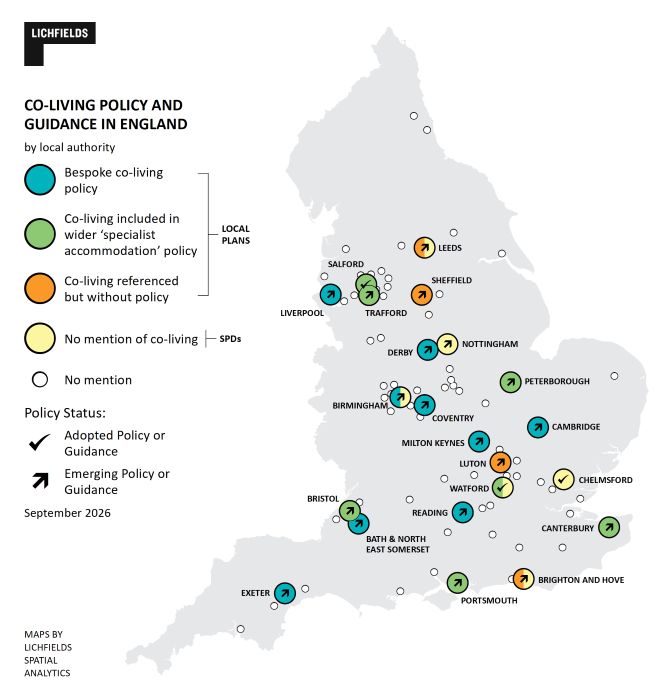
Lichfields reviewed the 84 local planning authorities in England most likely to see co-living activity. The review covered major urban areas, university towns and commuter towns around London; areas where we are seeing increased interest in the sector.
Adam Donovan, a Planning Director at Lichfields, said: “Councils need to plan for different types of housing if they are to meet the needs of people renting in their areas. Co-living can add to that choice, particularly in well-connected locations where residents have access to employment, services and public transport.
“The emerging policies are encouraging because they recognise a role for shared living. Setting expectations early allows developers to take them into account when selecting sites and designing schemes.”
The research found that emerging plans generally support co-living in accessible locations and established centres. Policies also cover affordable housing, room sizes, shared facilities and building management, although authorities vary in how much detail they provide.
Salford and Watford already refer to co-living in adopted local plans, while Birmingham, Leeds, Brighton and Hove, and Chelmsford have supplementary guidance. Other authorities are considering their approach through emerging plans.
Adam added: “London’s experience and established policy and guidance gives councils elsewhere a useful starting point. They can draw on established standards including sizes of co-living units and communal space while reflecting local housing needs.
“Policies should recognise how the accommodation is used and managed, giving councils a clear basis for assessing proposals and developers greater certainty about what is expected. That will help suitable schemes come forward alongside other forms of housing.”