External wall insulation systems may look broadly similar once the final render has been applied, but what sits behind that finish can vary considerably.
The insulation board is one of the most important components.
Expanded polystyrene, mineral wool, phenolic insulation, wood fibre and other specialist boards each have different strengths. Choosing between them means considering more than thermal performance alone.
Fire behaviour, moisture management, wall thickness, acoustic performance, substrate and budget can all influence the decision.
Start with the property rather than the product
Before comparing boards, establish what the building actually requires.
Consider the existing wall construction, its condition and thickness, whether it is solid or cavity masonry and whether moisture needs to move through the wall.
The building's height and use may influence fire requirements. Available space around boundaries, paths and rooflines can affect the practical insulation thickness.
There may also be a target U-value that the upgraded wall needs to achieve.
These factors create the specification. The insulation board should then be chosen to satisfy it.
Why thermal conductivity matters
Insulation works by resisting heat flow.
Manufacturers usually express a material's thermal conductivity as a lambda value, represented by the Greek letter λ. Lower thermal conductivity means the material allows less heat to pass through a given thickness.
This is why two 100mm insulation boards are not necessarily thermally equivalent.
A high-performance phenolic board can provide greater thermal resistance at a given thickness than some other common insulation products.
Thickness and conductivity therefore need to be considered together.
The complete wall's U-value is more useful than comparing thickness alone because it considers the thermal performance of the overall construction.
Graphite EPS
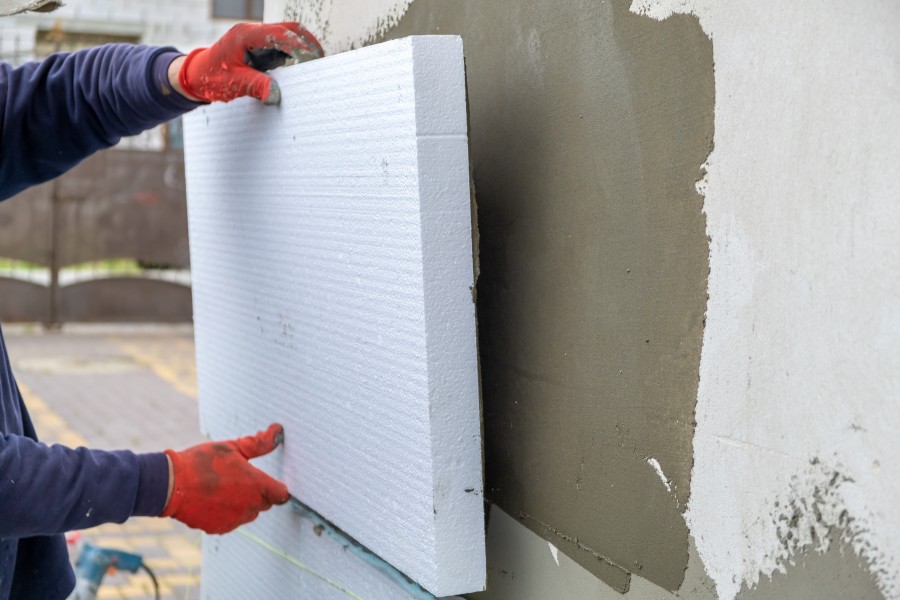
Expanded polystyrene is one of the most familiar external wall insulation materials.
Modern graphite EPS contains graphite particles that improve its thermal performance. The boards are easily recognisable from their grey appearance.
EPS has several practical advantages. It is lightweight, straightforward to cut and generally relatively economical. These characteristics make installation efficient and can help keep overall system costs manageable.
It is commonly used on houses where a practical balance between thermal improvement, thickness and price is required.
EPS is a combustible insulation material, however, meaning fire design and the requirements applicable to the specific building must be properly considered.
Mineral wool
Mineral wool insulation boards provide a different combination of characteristics.
One of their most important advantages is fire performance. Suitable mineral wool facade boards can achieve non-combustible classifications, making them an important option where the design places particular emphasis on fire safety.
Mineral wool is also vapour permeable.
This allows water vapour to move through the insulation more readily than through many closed-cell foam materials, which can be valuable in breathable wall systems.
Its fibrous structure can also help with acoustic performance.
The compromises are mainly practical and financial. Mineral wool boards are heavier than EPS and can require more careful handling and installation.
They can also increase system cost.
For the right building, however, those additional characteristics may make mineral wool preferable to simply choosing the lowest-cost insulation.
Phenolic insulation
Phenolic insulation is particularly useful when space is limited.
Its comparatively low thermal conductivity means a strong level of thermal resistance can be achieved with a slimmer board.
Imagine, for example, an external wall running alongside a narrow passage. Adding a very thick insulation system might make that route difficult to use. Similar constraints can arise beneath roof overhangs or around architectural features.
Using a higher-performance board can reduce the required build-up.
The main drawback is price. Phenolic insulation is typically a premium option, so it makes most sense when thickness has genuine value rather than simply being selected because it has the best thermal figure.
At EWI Store, we currently list Kingspan Kooltherm K5 as a phenolic external wall insulation board designed for situations where saving space is important.
Wood fibre
Wood fibre insulation takes a different approach.
It is manufactured from wood fibres and is associated particularly strongly with vapour-open construction.
This can make it appropriate for traditional buildings and retrofit systems designed around breathable materials.
Wood fibre can also provide useful thermal mass and acoustic characteristics.
However, it should not simply be swapped directly into a system designed for EPS. The render, basecoat, fixings and other components need to be compatible with the board and the intended wall build-up.
Wood fibre therefore makes most sense when breathability forms part of the design strategy from the beginning.
XPS
Extruded polystyrene, or XPS, is a rigid foam insulation with relatively low water absorption and high compressive strength.
Those characteristics make it particularly useful in demanding areas where moisture or physical loads need to be considered.
Depending on the designed system, it may be used for particular details rather than necessarily covering the whole facade.
Using specialist insulation in the areas where its properties are actually needed can be more sensible than specifying one material indiscriminately across the building.
Do you need to use the same insulation everywhere?
Not always.
Some external insulation systems use different materials at specific details.
The main wall might use one board while reveals, plinths or other constrained locations require a different solution.
What matters is that the combination has been properly designed and the junctions between materials are correctly detailed.
Mixing products without considering system compatibility can create weaknesses in an otherwise sound installation.
Think about the complete system
An insulation board cannot perform as intended if the surrounding system is poorly installed.
External wall insulation normally involves adhesive or another approved fixing method, mechanical fixings where required, reinforcement mesh, basecoat, primers, beads and a suitable decorative finish.
Windows, doors, pipes and rooflines also have to be integrated into the system.
When comparing each external insulation board, look at the products it is intended to work with rather than treating the board as an isolated purchase.
Our current board category illustrates the range of materials available, including graphite EPS, Rockwool and Knauf mineral wool products, Kingspan Kooltherm K5, XPS and STEICO wood fibre.
Don't choose purely by price per board
The cheapest individual board will not necessarily produce the cheapest completed project.
A board's dimensions, coverage, required thickness and fixing requirements all influence total material cost.
Labour matters too.
A lightweight board that is quick to cut and install may affect project cost differently from a heavier product requiring more handling.
Conversely, a more expensive high-performance insulation may solve a dimensional problem that would otherwise require costly alterations elsewhere.
Comparisons should therefore be made at system and project level.
Getting the specification right
For a straightforward low-rise masonry property where budget and thermal improvement are the priorities, graphite EPS may be appropriate.
Where fire performance, acoustic performance or vapour permeability have greater importance, mineral wool may become the stronger option.
Phenolic insulation is worth considering where wall thickness needs to be minimised, while wood fibre can be suitable for breathable or traditionally constructed buildings.
XPS and other specialist boards can address particular moisture or load requirements.
The best choice is not the material with the longest list of benefits. It is the material whose characteristics best match the building.
Frequently asked questions
Is EPS or mineral wool better for external wall insulation?
Both can perform very well. EPS is lightweight, thermally efficient and usually cost effective. Mineral wool provides different advantages including non-combustibility, vapour permeability and acoustic performance. The building's requirements determine which is more appropriate.
What insulation should I use when space is limited?
High-performance boards such as phenolic insulation are often considered where the available wall build-up is restricted because they can deliver greater thermal resistance within a slimmer construction.
Can I render directly onto insulation boards?
External wall insulation requires a designed reinforced system over the insulation. This generally includes appropriate basecoat, reinforcement mesh and a compatible finishing system rather than simply applying decorative render directly to an unsupported board.
Can I mix different insulation boards on one property?
Different insulation types can sometimes form part of one designed project, particularly around specialist details. They should not be mixed arbitrarily. Compatibility, fixings, fire design and the treatment of junctions all need to be considered.