Glenigan has released the August 2026 edition of its Construction Index, which focuses on the three months to the end of July 2026, covering all underlying projects, with a total value of £100 million or less (unless otherwise indicated), with all figures seasonally adjusted.
It’s a report which provides a detailed and comprehensive analysis of year-on-year construction data, giving built environment professionals a unique insight into sector performance over the last 12 months.
The August Index highlights that the UK construction sector remains firmly stuck in neutral, struggling to shift gears as a host of international and domestic socioeconomic headwinds strike it from all sides.
Whilst the fall in value of underlying projects starting on site in the previous three months (-11%) was slightly less severe than figures recorded in last month’s edition, performance remains well behind last year’s levels (-29%) which were, in turn, lower than 2024 results.
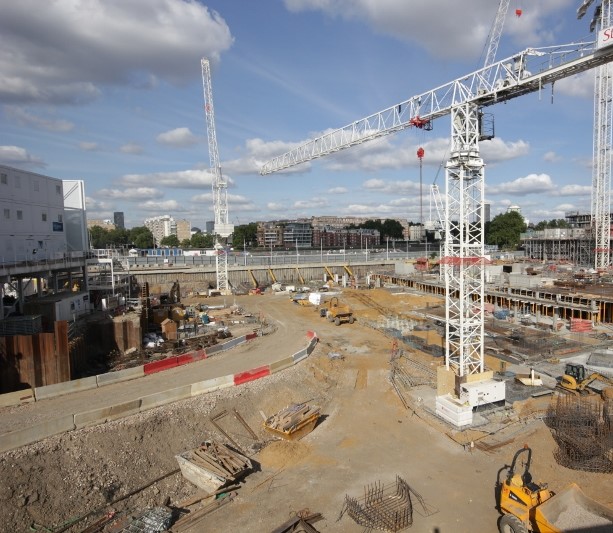
Ongoing international conflict and the political turbulence on the home front, that steadily increased over H.1 2026 is still sending shockwaves throughout the sector, with previously laid out plans at risk or being ripped up and private investors still uneasy about releasing investment.
Whilst residential construction remained stuck in the doldrums, there were a couple of growth areas in other verticals. Office starts were the outlier, posting positive stats during the Index period and compared to the previous year. Perhaps most compelling, civils work saw an impressive uptick quarter-on-quarter, implying that Spending Review money is starting to be released for infrastructure and utilities work.
Commenting on the Index, Glenigan’s Yuliana Ivanykovych says: “Try as it might the sector continues to be held back by external factors beyond its control, with a changing of the guard at the top of Government being the latest in a string of extraordinary events. Key barometers such as residential construction remain depressed will little immediate signs of the dial moving before the end of the quarter.
“With the new Prime Minister keen on hard hats over academic caps, we might yet see some movement here ahead of Winter, so I imagine the whole industry will be keenly looking on to see what further policy announcements he makes over the next few weeks. However, to slightly temper this optimism, there remains a considerable degree of uncertainty across global markets. Tough economic conditions out of Andy Burnham’s control might dent those ambitions usually achievable in normal economic circumstances.”
Sector Analysis – Residential
It was yet another poor period for residential construction which has been stuck in reverse for the past 12 months. Overall performance was down by a quarter (-25%) compared to the preceding three months, plummeting 46% against 2025 levels.
Digging deeper into the mire, private housing saw its project-start value slashed by a fifth (-21%) compared with the previous three months and in half (-49%) compared to last year.
Social housing project starts were similarly lacklustre, falling by a third (-34%) against the preceding three months, finishing 38% down on the previous year’s figures.
Sector Analysis – Non-Residential
According to Glenigan data, offices had a strong spell of growth. Rising 25% against the preceding three months it was the only vertical to outstrip 2025 activity, soaring by 34% over last year’s results.
Industrial activity, supported by a £74 million storage and distribution project in Leicestershire, increased almost a third (+30%) quarter-on-quarter, yet remained 6% lower than a year ago.
Similarly, Community and Amenity starts rose 18% against the preceding three months, however it had a steeper hill to climb when faced with 2025 figures, finishing 22% below last year’s level.
Performance was poor for the remaining verticals. Glenigan’s data revealed that retail declined, dropping 30% against the preceding three months to stand 16% below the previous year, whilst Hotel & Leisure activity fell 4% quarter-on-quarter and declined 26% year-on-year.
Health activity, buoyed by fundings gradually being released from the Government’s New Hospitals Programme, was broadly stable, dipping only 1% against the preceding three months and standing a mere 4% below a year ago.
On the other hand, Education has an abysmal Index period, nosediving 42% quarter-on-quarter and 37% below last year's level.
Sector Analysis - Civils
Hinting that the small shoots of revival might be taking root in civil engineering, work starting on site in this vertical lifted by 34% compared to the previous three months.
This relative growth can be attributed to a spike in both infrastructure and utilities activity during the Index period, with project starts up by a quarter (+24%) and by half (+51%) respectively. Projects including the £74 million Culham River Crossing in Oxfordshire and the £68 million flood protection scheme in Dumfries were partly responsible for this welcome uptick in a vertical that has experienced a particularly sluggish spell over H.1 2026.
However, this renewed momentum will have a long way to go to gather enough pace to outstrip 2025 levels, with performance remaining 15% lower than a year ago, with both sub-verticals down 16% (infrastructure) and 14% (utilities), respectively.
Regional Outlook
Glenigan’s data showed that regional performance was mixed, with most struggling to gain enough traction to match 2025 results.
The West Midlands proved the standout performer, possibly spurred on by the £53 million refurbishment and alterations services let by the West Midlands Police Authority, recording a 23% rise against the preceding three months, finishing almost a quarter (-24%) below the previous year.
The East of England also recorded growth, rising 7% against the preceding three months, though remaining 22% below the previous year. The South West increased 8% quarter-on-quarter but activity was still 45% lower than a year earlier. Yorkshire rose 13% against the preceding three months, though remained 36% below last year's level.
London experienced a relatively resilient period. Whilst project-starts declined a modest 5% quarter-on-quarter, figures held broadly in line with last year's level, up 1% year-on-year.
Elsewhere it was a story of decline and fall. The South East dropped 27% against the preceding three months and was 46% below last year. Scotland fell 20% quarter-on-quarter and 31% year-on-year. Wales also weakened, declining 37% quarter-on-quarter and 28% compared with a year earlier.
Northern Ireland, which had a comparatively stable H.1, compared to other regions, recorded one of the steepest drops, tumbling 52% against the preceding three months, to finish 22% below the previous year.
For further information, or to read more of Glenigan’s insights and reports, click here.