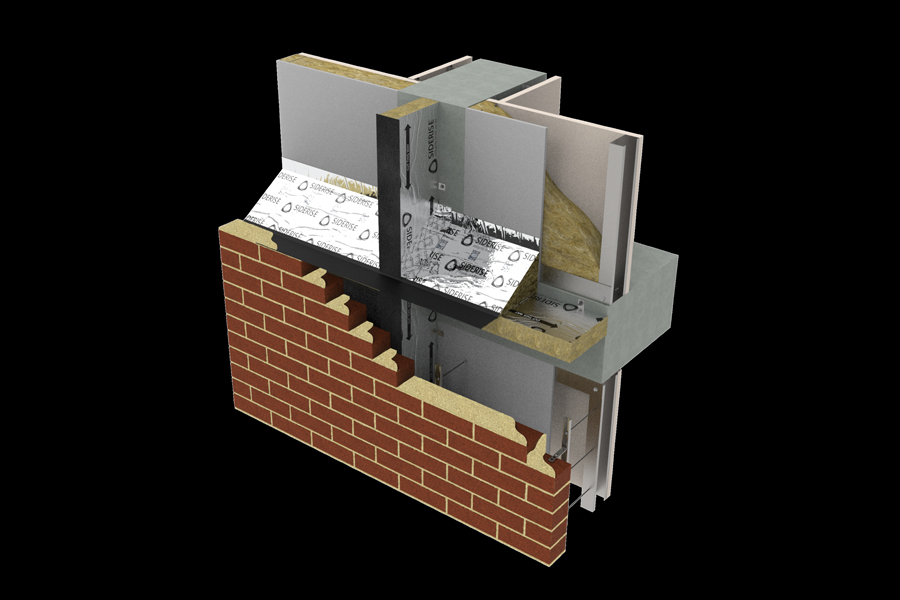
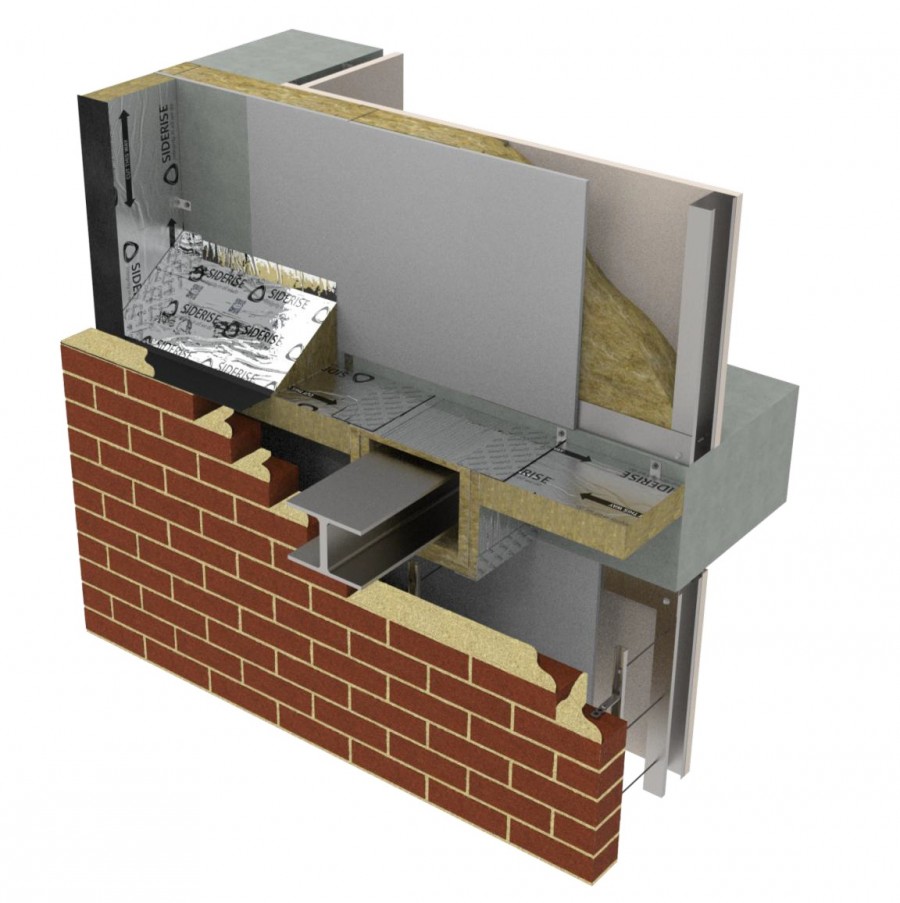
One of the key benefits of rainscreen façades is the wealth of cladding finishes available, including in an endless combination of sizes, colours and materials to choose from. However, the way the individual cassettes are formed and edges are folded often leaves a recessed back which, when installed on the support system, results in variable cavity depths across the façade. Profiled panels present a similar issue.
This can make it challenging to keep the air gap within permissible limits using horizontal and vertical cavity barriers alone, whilst also ensuring the outer face of the barriers has an even surface to form a seal against in a fire scenario. In some cases, complex folds in panel edges make it impossible for cavity barriers to infill the full extent of the voids behind them.
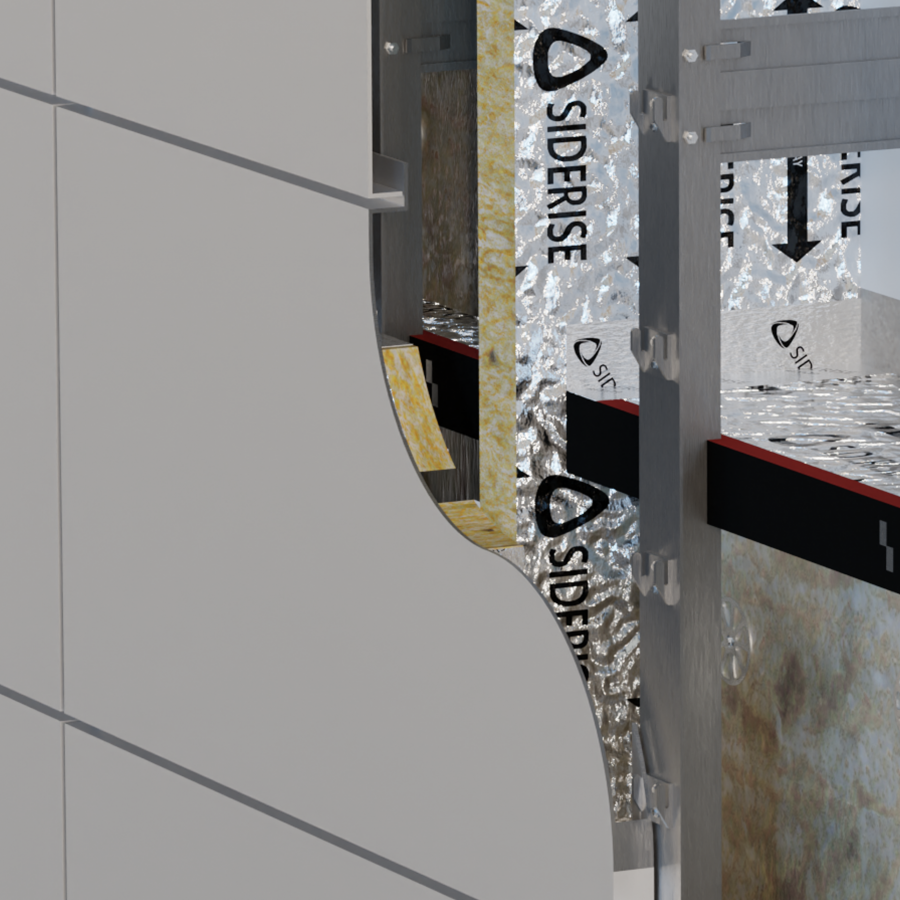
If not addressed during design and specification, this situation often means horizontal barriers must follow the profile of the cassette panel, and that installers must, where possible, manually notch and scribe the vertical fire barriers around the joints as the build programme progresses. Where hook-on panels are used, scribing is impossible, as the panel has to be offered into position before being lowered onto the supporting rails.
In addition to being highly time consuming to address, this complex and often project-specific detail cannot be clearly supported with standard fire test data, therefore requiring careful inspection and documentation to demonstrate that the installation is compliant. This could be a challenge on projects with tight deadlines or where buildings are subject to additional Building Control approvals under the new building safety regime.
Siderise OSCI Open State Cavity Insert offers a simple panel infill solution to this often-overlooked specification challenge. This small high-density block of foil faced Class A2-s1, d0 stone wool can be applied to the internal surface of cassette panels either by using the integral self-adhesive strip or mechanical retention methods with brackets or stick pins. This creates a consistent flat surface opposite the facing Siderise RH Horizontal Cavity Barrier, CH Horizontal Cavity Barrier or RV Vertical Cavity Barrier— providing a suitable interface for the barriers to seal against, addressing voids in front of obstructions such as support rails and folds in the panel edges by allowing the void to be closed off whilst simplifying their detailing and installation such as negating the need to notch to follow the profile of the cassette panel and ensuring that the ventilation air gap is consistent and compliant.
It is available in a range of thicknesses and widths to accommodate most types of rainscreen cassette panel designs and can be pre-cut to size under factory-controlled conditions to suit a specific panel depth. This allows it to be positioned around elements such as support rails or hook-on/bracket arrangements, making it ideal for both new build and façade remediation projects. For horizontal and vertical profiled cladding sheets, it can also be manufactured in bespoke forms to ensure an accurate fit.
In addition to having an A2-s1, d0 reaction to fire classification in accordance with EN 13501-1, the product has been included in large-scale fire tests of multiple cladding systems to standards such as BS 8414 and NFPA 285in conjunction with Siderise Cavity Barriers. It has also been put through EOTA TR 024 ‘Type X’ accelerated age testing to confirm it has a 60-year design life and subsequently tested in accordance with EN 1363-1 conditions to demonstrate the effectiveness of its adhesive facing in supporting it for a fire resistance period that exceeds the minimum requirements of Approved Document B for England and Wales and the Building Standards Technical Handbook for Scotland. Type X is the most onerous category, which replicates exposure to rain, UV, high temperatures, and frost and thaw cycles.
To learn more, visit the Siderise OSCI product page on siderise.com