A new and revised European standard for fire testing of building cladding will take effect on 31 January, 2026.
However, DBI encourages manufacturers to test according to the revised standard already now. The new standard will provide a more uniform safety level across countries, as well as new, flexible opportunities for manufacturers.
Building cladding such as plasterboards, wooden panels, and other boards mounted on walls and ceilings plays an important role in fire safety, as it must protect underlying materials in the event of a fire.
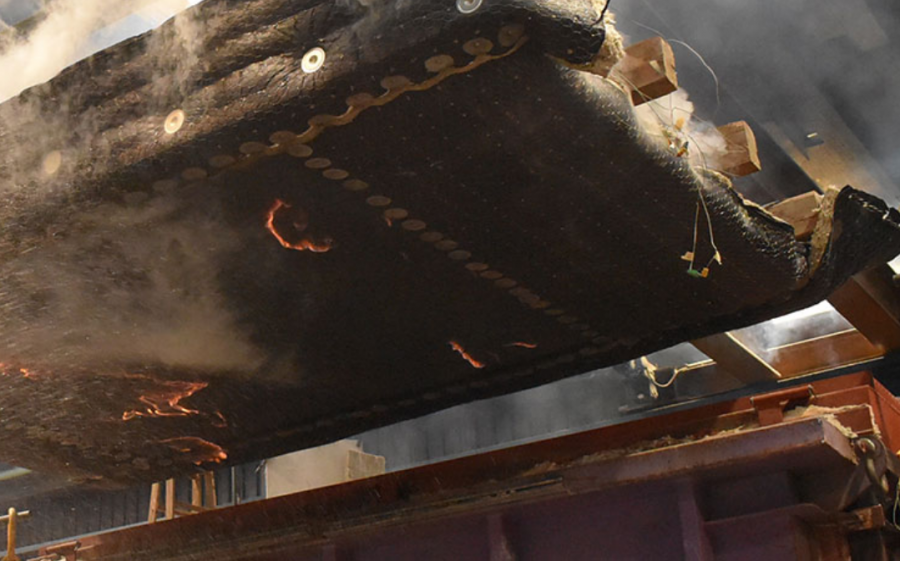
Today, when testing how a cladding performs under fire exposure, the assessment is made visually – something that inevitably depends somewhat on the eye of the beholder. In the current standard, for example, it is up to a visual assessment to decide whether the underlying particleboard is charred after the test. This can produce different results depending on which laboratory conducts the test.
“It can be a bit subjective and cause variations from lab to lab. Disagreements often arise in borderline cases,” says Jeanne B. Kirk, Resistance to Fire Engineer at DBI – Danish Institute of Fire and Security Technology.
The new standard aims to address these challenges by introducing a temperature-based method in which pass/fail is determined from measured temperatures – e.g., whether they rise more than 270°C. DBI has been involved in developing the specifications for where and how temperature sensors should be placed in the setup to provide an accurate picture of whether the underlying material risks becoming charred.
“It’s about getting data sets that show how the material actually performs. If the temperature exceeds the limit, it automatically fails. This makes the conclusion much more objective,” says Jeanne B. Kirk.
In the European classification system, K1 10 and K2 30 are used to indicate that a cladding must protect the underlying material from fire exposure for 10 or 30 minutes, respectively. These classes have different requirements and application areas, including where and how the material may be installed. The new standard adjusts and expands the requirements for how these classes are documented to avoid a product being approved for an application for which it is not truly suited.