Professor Cath Noakes OBE, Professor of Environmental Engineering for Buildings at the University of Leeds, will deliver the keynote address at this year’s BESA National Conference in London on October 20.
Professor Noakes FREng FIMechE, who co-chaired the Environment and Modelling Group of the government’s Scientific Advisory Group for Emergencies (SAGE) during the pandemic, will emphasise the importance of addressing ventilation as part of the unprecedented national focus on making buildings safer and healthier.
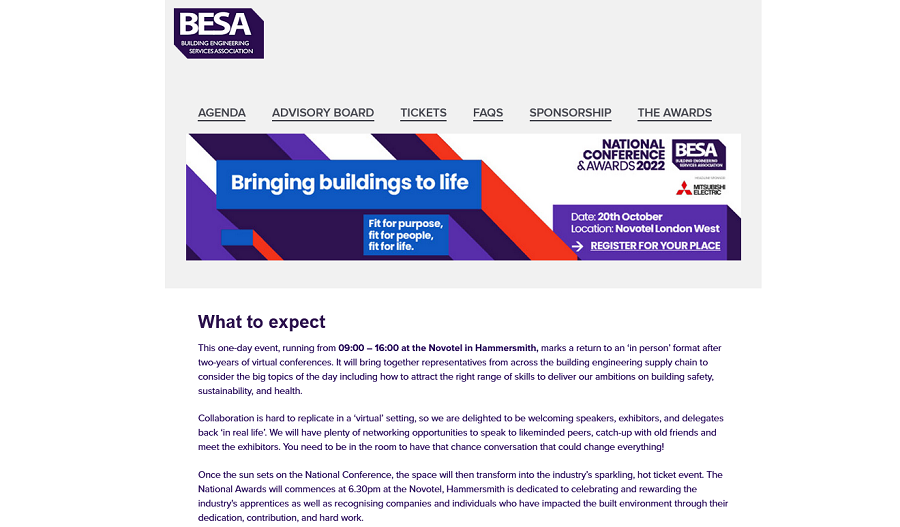
The Conference, which takes place at the Novotel London West in Hammersmith, has an over-arching theme: ‘Bringing buildings to life’ and will feature a wide range of speakers considering how the industry can make buildings “fit for people, fit for purpose, and fit for life”.
The one- day event marks a return to an ‘in person’ format after two-years of virtual conferences. It will bring together representatives from across the building engineering supply chain to consider the big topics of the day including how to attract the right range of skills to deliver our ambitions on building safety, sustainability, and health.
The keynote presentation by Professor Noakes: ‘Ventilation – the most overlooked building safety issue’ will focus on the opportunity created by the Building Safety Act, which was introduced earlier this year, to bring about the biggest change to health and safety culture in construction for half a century.
Resilience
She will explain why it is vital that the industry does not miss this opportunity to improve the infection resilience of buildings and address the ongoing health crisis caused by poor ventilation.
While the risk of fires is the primary focus of the new legislation in the wake of the Grenfell Tower disaster, Professor Noakes will explain that it is highly probable that the poor standard of building ventilation can be linked to many more deaths.
“Covid-19 has been shown to be transmitted through the air. Even if only 10% of all Covid-19 related deaths could be directly attributed to the failure to adequately ventilate indoor spaces, that would be more than 15,000 since the start of the pandemic – a shocking statistic that should make everyone sit up and take notice,” she says.
Professor Noakes, who is also deputy director of the Leeds Institute for Fluid Dynamics, has already contributed to several BESA webinars and wrote the foreword to its latest Indoor Air Quality (IAQ) publication: ‘Buildings as Safe Havens – a practical guide’.
She says the pandemic taught us “a tremendous amount about the importance of better ventilation to make buildings more infection resilient”.
“We now have clear epidemiological evidence that better ventilation reduces the risk of airborne virus transmission, and several studies for a range of diseases suggest the reduction in risk may be between 30% and 50%. But we have also known for decades about the link between good ventilation and better sleep, productivity, and a reduction in respiratory conditions such as asthma.
“Computer modelling and analysis of outbreak data were key to understanding that we were facing an airborne threat from Covid-19. Subsequent studies have also revealed vital information about the possibility of room-to-room transmission in the most infectious cases due to the pressure differences that allow airborne pathogens to travel relatively long distances,” she explained.
Professor Noakes’ will focus on the fact that far too many of UK buildings are simply under-ventilated despite the clear guidelines and regulatory requirements that have been in place for many years.
“The recommended ventilation rate of 10 litres per person per second of clean air is likely to be very effective for protecting health and well-being, but many buildings fail to achieve this level,” she says. “While the new regulations are welcome, it is essential that we improve our delivery of the air quality standards that have been in place for many years.”
She will outline why the challenge for every building owner and operator is not always to deliver more air, but the right amount of cleaner air, and what the building engineering sector can do to help them achieve that efficiently and cost-effectively.
Strategy
“To make buildings more resilient we need both short-term solutions and a long-term strategy. For example, local air cleaners based on HEPA filtration or UVC disinfection are important tools, but they are not an alternative to improving the general ventilation,” says Professor Noakes.
Nathan Wood, chair of BESA’s Health & Well-being in Buildings group, welcomed Professor Noakes’ continued support for the Association’s IAQ and ventilation work.
“Most buildings in this country do not have any active ventilation management,” he said. “At the top end of the market, the issue is well understood, and expertise is on hand to put best practice into effect, but the rest of the sector is suffering from a huge competence and compliance gap.
“This year’s BESA National Conference is an opportunity to promote the urgent need for an enlarged expert workforce qualified to help the thousands of buildings that have no ventilation strategy and are, therefore, unprepared for the next health emergency. They also struggle to deal with day-to-day problems such as the spread of colds and flu,” said Wood, who is chairing two presentations and debates focused on safety and air quality during the Conference.
He said the Association would be accelerating its ongoing campaign for buildings to be designed as ‘safe havens’ that protect occupants from the worst impacts of external and internal air pollution.
“BESA’s suite of free indoor air quality (IAQ) guidance is an invaluable tool that can help us develop a larger and more competent specialist workforce able to take the lessons we have learned about how ventilation can make buildings more infection resilient and turn them into practical measures,” added Professor Noakes.