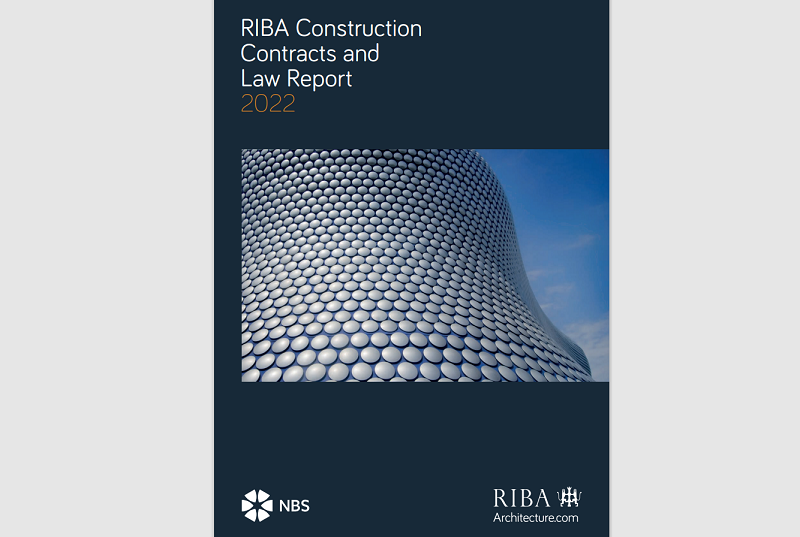
The Royal Institute of British Architects (RIBA) has published the findings of its survey construction professionals on their experience of legal and contractual practice over the past twelve months.
The survey, supported by NBS, forms part of the 2022 Contracts and Law Report, which is complemented by a series of articles from cross-sector experts. It was completed by over 950 clients, contractors and consultants including architects between January and April 2022.
Key findings show:
- 43% of respondents were involved in one or more contracts that included ‘expected sustainable outcomes’ and 32% that included ‘measurable sustainability criteria’.
- 23% said that 'operational performance criteria’ had become a contractual requirement, while 21% referenced ‘embodied carbon criteria’ – metrics that form part of the RIBA 2030 Climate Challenge.
- 7% of respondents had been involved in a contract that included the UN Sustainable Development Goals.
- 57% said they adopted collaboration techniques on some or all projects, with almost a quarter (22%) adopting collaboration techniques on all projects.
- 63% said that collaboration techniques reduced the number of disputes, and 61% said they improved the delivery of the client’s objectives.
- The proportion of respondents being involved in contractual disputes fell from 44% in 2015, to 33% in 2018, to 27% this year.
In terms of participants, 86% were consultants (including architects and surveyors), 5% were contractors and 5% were clients.
The report is complemented by articles from:
- Professor Sarah Lupton, and Manos Stellakis, on ‘evolving procurement options’, on behalf of the RIBA.
- Roland Finch, Independent Contracts and Specification Specialist, on ‘Build Back Better’ on behalf of the RICS.
- Marc Hanson, Partner Bryan Cave Leighton Paisner LLP, on ‘contracting post pandemic’, On behalf of the BPF.
- Inkar Tebenova, Senior Project Manager, Arup, on ‘how the contracting landscape has changed post-pandemic’, on behalf of the APM.
- Rosemary Beales, Contracts Adviser, the Association for Consultancy and Engineering on why 'building trust has never been more important', on behalf of the ACE.
- Kate Foster, Technical Author, NBS, on 'when uncertainty persists, be sure about specification', on behalf of NBS.
Commenting on the findings, RIBA Executive Director Professional Knowledge and Standards, Adrian Dobson, said: “We can expect to see demands for sustainable outcomes grow significantly over the coming years. From government departments and agencies, from project funders and financiers, and through tighter legislation and standards – the contractual expression of sustainable outcomes will become progressively mainstream. I am therefore encouraged to see growing appetite for contracts that include sustainability criteria.
“Across the industry, we need to be designing, specifying, procuring, managing and measuring sustainable buildings now. Sustainability isn’t just aspiration and altruism. It’s increasingly the bottom line. The strong adoption of collaborative techniques and declining number of disputes is also encouraging, particularly during such an unpredictable and volatile period, demonstrating the resilience of the sector.
“It also stresses the importance of construction contracts that facilitate collaborative behaviour and clearly delineate areas of responsibility.”
RIBA Head of Economic Research and Analysis, Adrian Malleson, said: “From navigating the complexities of Brexit to the uncertainty of the Covid-19 pandemic, the past three years have been particularly tough for the construction sector.
“Project delivery has been risky and – as these findings suggest – it’s through increased collaborative working and mutual support that the sector has continued to deliver, and the number of those pursuing dispute resolutions has declined.
“The findings support the view that the bedrock of a successful project is a clear, well understood, proportionate, timely and agreed contractual framework. It’s only through accurate quantification, description and allocation of cost and responsibility that expected outcomes can be realised by and for all parties.
“Ultimately, to continue to meet the challenges ahead, the sector must work collaboratively, project by project, on a foundation of clear contractual understanding and agreement.”