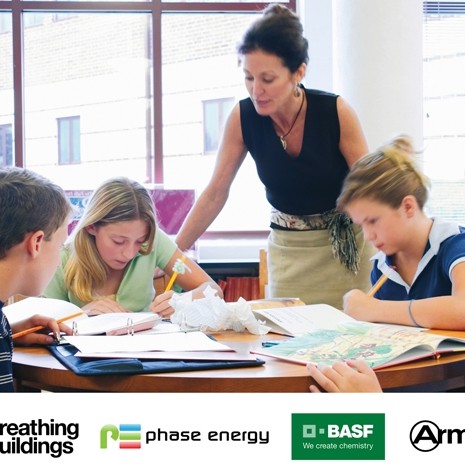
Interior building solutions provider Armstrong Ceilings was quick off the mark when the Government recently announced Phase Two of its Priority School Building Programme (PSBP).
For shortly after Deputy Prime Minister Nick Clegg said the programme would benefit thousands of pupils with better, brighter, warmer classrooms, Armstrong was hosting a seminar advising specifiers and contractors just how they could achieve cost-effective thermal comfort solutions.
Devised specifically for construction professionals who want to design schools which are quick to build and meet the new regulations for ventilation and thermal comfort, specifically the Output Specification, the event at The Building Centre in London was an interactive mixture of presentation and discussion.
More than 40 architects, services engineers and contractors heard Armstrong’s head of sustainability Jeremy Sumeray explain how the PSBP provided an ideal opportunity for lightweight thermal mass to help designers and specifiers achieve the new Output Specification.
Phase 2 of the PSBP will rebuild or refurbish 277 schools across England at a cost of £2billion, at a faster, cheaper rate than the programme’s BSF (Building Schools for the Future) predecessor which was criticised for turning out schools that were not fit for purpose.
He revealed how the use of such lightweight thermal mass – recyclable ceiling tiles which incorporate phase change material (PCM) - in a classroom at Belvoir High School in Nottingham had resulted in consistently lower peak temperatures with natural ventilation compared to an identical classroom with standard ceiling tiles.
He also demonstrated how tests in an insulated thermal chamber showed that the CoolZone ceiling tiles could delay the use of air conditioning by between four and eight hours depending on coverage, cooling load and air conditioner configuration, and that they could reduce temperature variations on the ceiling by +/- 1ËšC.
The seminar also heard from Prof Shaun Fitzgerald, CEO of ventilation specialists Breathing Buildings, that the Output Specification demands classrooms be designed to meet new standards of operative temperature.
He also advised that the average internal temperature of a classroom should not exceed the average external temperature by more than 5ËšC, and that this should be regulated by passive cooling, with thermal mass and night ventilation, and only limited use of mechanical cooling to high heat gain areas.
Ian Biggin, director at PCM consultancy Phase Energy, explained that PCMs are thermal mass, not insulation, although they should be used in association with other temperature control methods such as insulation, shading, orientation and ventilation. PCMs provide intelligent thermal mass that allows buildings to heat up and cool down quickly but buffer the temperature effectively in the “comfort range”. This is particularly important in buildings with little exposed thermal mass, that is lightweight structures and buildings where the thermal mass has been decoupled from the room air, for example by internal wall insulation or dry lining.
Marco Schmidt, head of business management Micronal PCM at chemical company BASF SE, revealed that a calculation tool (a PCM planning App) in the final stages of development can help planners of heating, cooling and ventilation systems estimate the benefit of using PCMs and exactly how they should be integrated.
Lastly, Alan Jones of software developers EDSL demonstrated how their TAS building simulation software could help with the design of schools to meet the new Output Specification in the area of thermal comfort.
Hosted by leading sustainability journalist and blogger Hattie Hartman, the seminar was very well received and is likely to be the first of many.
Anyone who was unable to attend the event can view a live blog on it via a link on Armstrong’s website home page or https://storify.com/subutcher/cost-effective-thermal-comfortsolutions-for-the-p.