The combination of rising energy costs and client demands to improve the environmental performance of buildings is making architects look carefully at raising environmental standards, according to a recent study by Glenigan* entitled The Future of Low Carbon Construction. The study reveals that buildings account for 43 per cent of the UK's CO2 emissions. It is not surprising then that over two thirds of the 6000 architects who took part in the study reported that reducing the building’s carbon emissions is a highly important factor at design stage. It therefore follows that specifying materials to conserve energy when designing a building of low environmental impact is very important. There is little doubt that low carbon impact materials will be increasingly specified in the future as the trend towards more energy efficient building envelope technologies continues to gather momentum considering the government commitment to zero carbon housing.
It is well documented that insulation is the one of the most important elements for energy efficiency; a key component in reducing energy bills and in delivering buildings with a lower environmental impact It is therefore important to ensure the insulation of the whole building fabric (exterior walls, ceiling/roof, floor, foundations) with the maximum amount and right type of insulation material. This ‘fabric first’ philosophy is one held by the BRE who established the National Refurbishment Centre to support the practical delivery of green refurbishment and retrofit. The NRC is gathering evidence from a nationwide demonstration network of up to 500 refurbishment projects on energy efficient installations. As insulation is a key driver in this initiative, construction materials manufacturer BASF has become a lead member in the NRC scheme, providing whole building insulation solutions through a broad range of product offering.
When designing new properties, eliminating air leakage needs to be considered by specifiers at an early juncture. Only if air tight insulation materials are specified at the design stage and installed correctly during the construction programme will building owners and occupiers benefit from future energy savings
- It is not only the initial cost of specifying such materials that needs to be considered but also the future maintenance of the energy saving elements that need to be considered. A significant proportion of heat loss is due to uncontrolled air leakage, insufficient insulation, inefficient windows and doors or inefficient home appliances, etc., for example: up to 60% heat can be lost from uninsulated walls & roofs which equates to a lot of wasted energy and hence increased CO2 emissions. Installing insulation can produce savings of around £375 a year on heating bills and reduce emissions by around two tonnes of carbon dioxide (CO2) each year, according to the CPA (Construction Products Association)**Cavity wall insulation – potential savings of around £115 a year on heating bills; polyurethane insulation also reduces emissions by more than 1000kg CO2 per year.
- Loft insulation - savings of around £150 a year on heating bills and reduces emissions up to 1530kg CO2 each year with spray foam insulation depending on the size of property and fuel type.
- Draught proofing around doors and windows - savings of around £25 a year can be achieved on heating bills, reducing emissions by around 130kg of CO2 each year.
With fuel prices further increasing, a more wholistic view on insulation and the building fabric is required to off-set or reduce cost and carbon emissions.
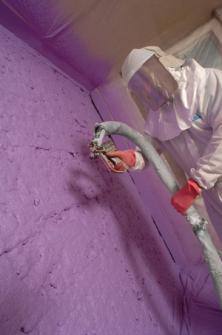
WALLTITE®, a spray applied or injected polyurethane foam from BASF Polyurethanes, has excellent thermal properties, and provides an air barrier which improves the overall air tightness of the building envelope without need of supplementing materials such as tapes or gapfillers. This is a significant factor in reducing overall heating bills and thus CO2 emissions.
CO2 Emissions Reduced by 75% at the Green House Project
The Green House Project has proven that carbon emissions can be reduced by 75% through easily inexpensive improvements. Working with Huntingdonshire District Council and the Building Research Establishment (BRE) as part of their ‘Rethinking Refurbishment’ campaign, BASF Polyurethane supplied and installed two WALLTITE products for this project. The two refurbished 1970’s houses in St Ives and St Neots are now open to the public in order to demonstrate how affordable, energy efficient homes can be achieved. The project concentrated on using a variety of insulation techniques to provide a reduced carbon footprint for the district across both properties coupled with homes brought up to a higher level of environmental performance with exciting results.
Following the BRE tests and assessments, the St Ives property improved the SAP score from 48 to 83 and improved the EPC rating from E to B. The initial assessment of CO2 emissions was 5900kg p.a. which reduced to 1500 kg p.a. following the improvements which resulted in an estimated reduction in energy bills of £633 per year.
At the St Neots house, the SAP score improved from 46 to 85 and EPC rating from E to B, with a similar reduction in CO2 emissions from 5200kg p.a. to 1300 kg p.a. resulting in reduced energy bills of £478 per year.
The houses are now open for viewing which will allow visitors to receive practical and inspiring ideas on how to make their own homes warmer, brighter and cheaper to run whilst reducing their impact on the environment. Both properties have gained ‘Super Home’ status by the Sustainable Energy Academy (SEA) and have become part of the network for Super Homes across the UK. The St Ives property will also be used as a local Energy Saving Trust satellite advice centre, providing information, home energy checks, and advice on grant assistance, renewable technologies and feed-in-tariffs.
As part of the Climate Change Act to reduce carbon emissions within the current housing stock by 2050, the Green House project shows how simple, easily affordable improvements can be made to existing properties to work towards and meet these challenges head on.
*The Future of Low Carbon Construction is available from Glenigan at: http://www.glenigan.com/projects/e/low_carbon_construction.aspx
**Construction Products Association (CPA) entitled, ‘An Introduction to low carbon domestic refurbishment’
For more information visit www.walltite.basf.co.uk or contact BASF Polyurethane on 01773 601166: